
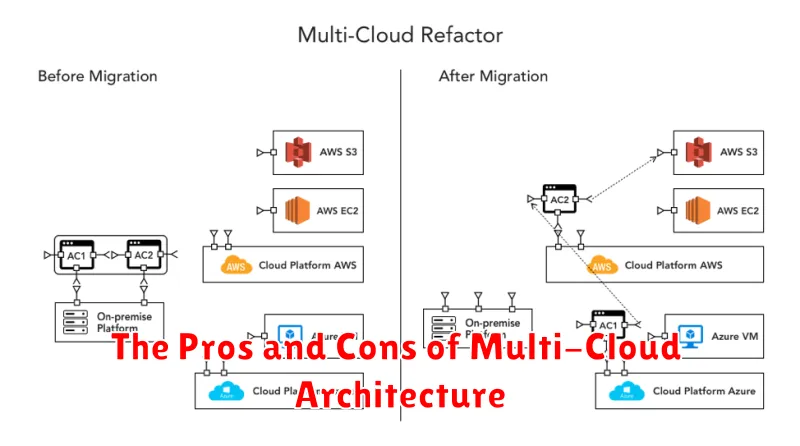
In today’s rapidly evolving digital landscape, businesses are increasingly turning to multi-cloud architectures to enhance scalability, resilience, and agility. A multi-cloud strategy involves distributing workloads across two or more cloud providers, offering a potent alternative to relying solely on a single vendor. Understanding the pros and cons of multi-cloud architecture is crucial for making informed decisions about your organization’s infrastructure. This article delves into the advantages and disadvantages, providing a comprehensive overview of multi-cloud deployments, multi-cloud management, and the inherent multi-cloud challenges.
Embracing a multi-cloud approach can offer significant benefits, such as avoiding vendor lock-in, optimizing costs by leveraging different pricing models, and enhancing disaster recovery capabilities. However, implementing and managing a multi-cloud environment also presents its own set of complexities. Increased management overhead, security concerns, and integration challenges are some of the potential drawbacks that need careful consideration. By exploring both the advantages and disadvantages of multi-cloud, you can determine if this powerful architectural approach aligns with your specific business needs and technical capabilities. This exploration will equip you to navigate the multi-cloud landscape effectively.
What Is Multi-Cloud Architecture?
Multi-cloud architecture refers to the strategic use of cloud services from more than one cloud provider. This contrasts with a single-cloud approach, where all cloud services are sourced from a single vendor. In a multi-cloud setup, organizations leverage various cloud platforms, potentially combining Infrastructure-as-a-Service (IaaS), Platform-as-a-Service (PaaS), and Software-as-a-Service (SaaS) offerings from different providers.
Organizations often adopt multi-cloud to avoid vendor lock-in, enhance resiliency by distributing workloads, leverage specialized services from different providers, or optimize costs by taking advantage of competitive pricing. A multi-cloud strategy requires careful planning and management to ensure seamless integration and interoperability between different cloud environments.
Advantages of Multi-Cloud Strategy
Leveraging a multi-cloud strategy offers several key advantages. Avoiding vendor lock-in is a primary benefit, as distributing workloads across multiple providers prevents dependence on a single vendor’s services and pricing. This fosters greater negotiating power with providers and encourages competitive pricing.
Increased resilience and availability are also significant advantages. By distributing applications and data across multiple clouds, organizations minimize the impact of outages or disruptions affecting a single provider. This enhances business continuity and disaster recovery capabilities.
A multi-cloud approach can also improve performance and latency. Strategically locating resources closer to end-users in different geographic regions optimizes performance and reduces latency for a better user experience.
Risk Management and Redundancy
A key advantage of multi-cloud architecture lies in its inherent risk mitigation capabilities. By distributing workloads across multiple cloud providers, organizations reduce their dependence on a single vendor. This minimizes the impact of outages, service disruptions, and even vendor lock-in.
Redundancy is a crucial aspect of this risk management strategy. If one cloud provider experiences an issue, applications and data can seamlessly failover to another, ensuring business continuity. This built-in redundancy strengthens the overall resilience of the IT infrastructure.
Challenges and Limitations
While multi-cloud offers significant advantages, it also presents certain challenges. Complexity is a primary concern. Managing multiple cloud providers requires specialized expertise and sophisticated tools to orchestrate operations across diverse environments. This includes managing different APIs, security protocols, and billing systems.
Security can also be more challenging in a multi-cloud environment. Maintaining consistent security policies and ensuring compliance across different providers requires careful planning and implementation. Data governance and regulatory compliance become more complex, requiring a thorough understanding of each provider’s security posture.
Another potential limitation is interoperability. Ensuring seamless data transfer and application portability between different cloud environments can be difficult. Different cloud providers utilize varying technologies, which can create integration challenges.
Security and Compliance in Multi-Cloud
Security and compliance are arguably more complex in a multi-cloud environment. Managing consistent security policies and controls across different cloud providers requires careful planning and implementation. Each provider has its own security tools, configurations, and compliance certifications.
Organizations must ensure interoperability and consistent enforcement of security measures. This includes identity and access management, data encryption, vulnerability management, and incident response. Maintaining compliance with industry regulations (e.g., HIPAA, GDPR) becomes more challenging due to the distributed nature of the infrastructure.
Implementing a centralized security management platform can help streamline security operations and ensure consistent policy enforcement across multiple cloud environments. Thorough due diligence is crucial when selecting cloud providers to ensure their security posture aligns with the organization’s requirements.
Managing Costs and Complexity
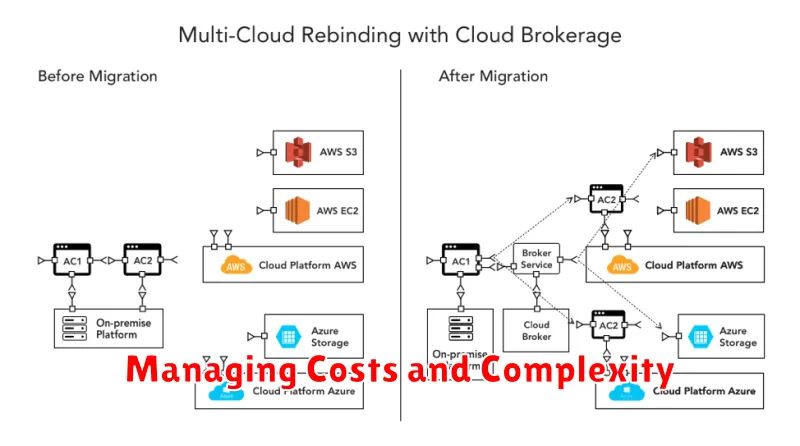
A significant challenge with multi-cloud architectures is the increased complexity. Managing multiple cloud providers involves juggling different platforms, tools, APIs, and billing systems. This complexity can lead to increased management overhead, requiring specialized skills and potentially larger teams.
Cost management also becomes more intricate. While multi-cloud can offer potential cost savings through leveraging competitive pricing, the complexity of managing multiple billing systems and optimizing resources across different environments can negate these benefits if not carefully controlled. Unexpected expenses can arise from data transfer fees, egress charges, and variations in pricing models.
Best Use Cases for Multi-Cloud
Leveraging multiple cloud providers can be a strategic advantage in certain situations. One common use case is disaster recovery, where a secondary cloud platform ensures business continuity if the primary provider experiences an outage.
Optimizing for specific workloads is another compelling reason. Different clouds excel in different areas. One might offer superior machine learning capabilities while another provides more cost-effective storage. Distributing workloads strategically capitalizes on these strengths.
Finally, multi-cloud can be a powerful tool for avoiding vendor lock-in. By maintaining a presence across multiple platforms, organizations retain greater negotiating power and flexibility.
