

In today’s digital landscape, cloud hosting has become an essential component for businesses and individuals seeking a reliable, scalable, and cost-effective solution for their website and application needs. But what exactly is cloud hosting? This comprehensive guide will delve into the intricacies of cloud hosting, explaining its core principles, advantages, and how it functions to provide unparalleled flexibility and performance. Understanding cloud hosting is crucial for making informed decisions about your online presence, whether you’re launching a new website, expanding an existing platform, or seeking a more robust infrastructure.
Unlike traditional hosting methods that rely on a single physical server, cloud hosting leverages a network of interconnected servers, forming a “cloud.” This distributed architecture offers numerous benefits, including enhanced redundancy, increased availability, and improved scalability. We’ll explore the various types of cloud hosting, including public, private, and hybrid clouds, and discuss their respective use cases. By the end of this article, you’ll have a thorough understanding of cloud hosting and be equipped to choose the best solution for your specific requirements.
Understanding the Basics of Cloud Hosting
Cloud hosting differs significantly from traditional web hosting. Instead of relying on a single server, it utilizes a network of interconnected servers, often referred to as a “cloud“. This interconnected nature provides several key advantages.
Scalability is a defining feature. Resources, like processing power and storage, can be easily adjusted to meet fluctuating demands. This flexibility eliminates the need to anticipate peak traffic and purchase excess capacity beforehand.
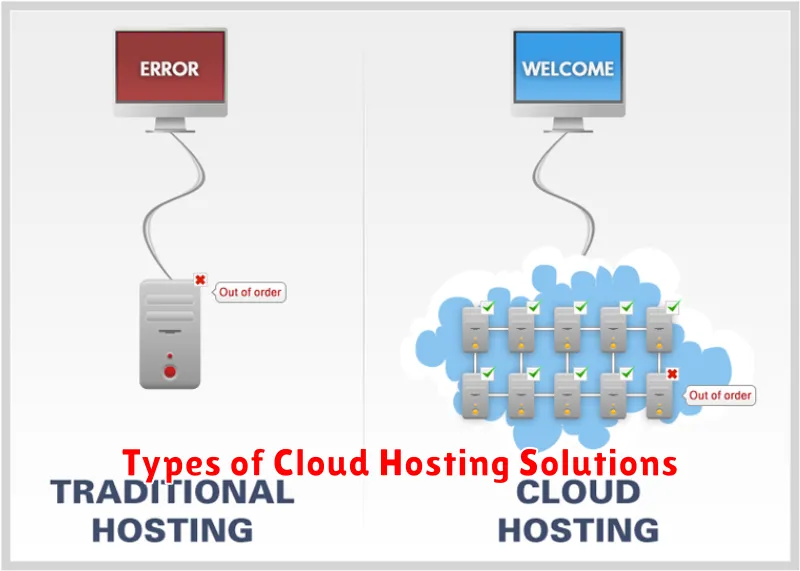
Reliability is another core benefit. If one server within the cloud experiences issues, the others seamlessly absorb the load, ensuring continuous website availability. This redundancy minimizes downtime and provides a more robust hosting solution.
Key Differences from Traditional Hosting
Cloud hosting diverges significantly from traditional hosting methods in several key aspects. Traditional hosting, encompassing shared, VPS, and dedicated servers, relies on physical infrastructure. In contrast, cloud hosting utilizes a network of interconnected servers, offering greater scalability and resilience.
Resource Allocation is another differentiator. Traditional hosting allocates specific resources to each user, sometimes leading to underutilization or resource constraints. Cloud hosting dynamically allocates resources based on demand, optimizing efficiency and cost-effectiveness.
Finally, fault tolerance is significantly enhanced with cloud hosting. If one server fails in a traditional setup, the website goes down. The distributed nature of cloud hosting ensures redundancy. If one server fails, another seamlessly takes over, ensuring continuous uptime.
Scalability and Flexibility

Cloud hosting offers unparalleled scalability. Resources like processing power, storage, and bandwidth can be easily adjusted to meet fluctuating demands. This allows you to scale up during peak times and scale down during quieter periods, optimizing resource utilization and cost efficiency.
Flexibility is another hallmark of cloud hosting. It supports a wide range of operating systems, programming languages, and applications. This adaptability allows businesses to tailor their hosting environment to their specific needs without being constrained by physical hardware limitations.
Benefits for Small Businesses
Cloud hosting offers numerous advantages for small businesses. Cost-effectiveness is a primary benefit, eliminating the need for expensive hardware and IT infrastructure. Pay-as-you-go models allow businesses to scale resources as needed, avoiding upfront investments.
Scalability and flexibility are also key. Cloud hosting allows businesses to easily adjust resources to accommodate growth or seasonal fluctuations in demand. This agility ensures optimal performance without overspending on unused capacity. Furthermore, cloud hosting enhances collaboration by enabling employees to access data and applications from anywhere with an internet connection.
Data security and disaster recovery are significantly improved with cloud hosting. Reputable providers offer robust security measures and data backups, protecting valuable business information from loss or theft. Automated backups and disaster recovery plans minimize downtime in case of unforeseen events.
Types of Cloud Hosting Solutions
Several cloud hosting solutions cater to diverse needs. Understanding these types is crucial for selecting the right one for your specific requirements.
Public Cloud
Public cloud hosting is the most common type, offering scalability and cost-effectiveness. Resources are shared among multiple users and managed by a third-party provider.
Private Cloud
Private cloud hosting provides dedicated resources and enhanced security for a single organization. It can be managed by the organization or a third-party provider.
Hybrid Cloud
Hybrid cloud hosting combines public and private cloud environments, allowing organizations to leverage the benefits of both. This offers flexibility and control over sensitive data.
Cloud Hosting vs VPS Hosting
While both cloud hosting and VPS hosting offer more resources than shared hosting, they differ significantly in their underlying architecture. VPS hosting utilizes a single physical server, partitioning it into multiple virtual servers, each with dedicated resources. This can lead to resource contention if one virtual server experiences a spike in usage.
Cloud hosting, however, leverages a network of interconnected servers. Resources are pooled and distributed dynamically, offering greater scalability and redundancy. If one server fails, the websites hosted on it are automatically shifted to another server within the network, minimizing downtime.
Is Cloud Hosting Right for You?
Choosing the right hosting solution depends heavily on your specific needs. Cloud hosting offers compelling advantages, but it’s not a one-size-fits-all solution. Consider whether cloud hosting aligns with your requirements.
If you need scalability and the ability to handle traffic spikes effortlessly, cloud hosting excels. Its pay-as-you-go model makes it cost-effective for fluctuating demands. Reliability is also a key strength, with redundancy minimizing downtime. However, if your website traffic is consistently low and predictable, a more traditional hosting solution might be sufficient.
Security considerations are crucial. While cloud providers invest heavily in security measures, you retain responsibility for securing your applications and data. If you lack the technical expertise or resources to manage security effectively, this could be a drawback. Finally, consider your budget. While cloud hosting offers flexibility, unforeseen traffic spikes can lead to unexpected costs if not carefully monitored and managed.
