
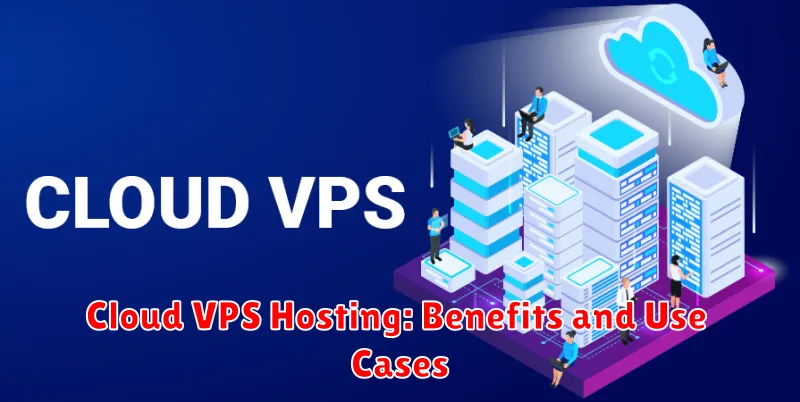
In today’s digital landscape, businesses are constantly seeking robust and scalable hosting solutions. Cloud VPS hosting emerges as a powerful option, offering a blend of the flexibility of cloud computing with the control and resources of a virtual private server. This article explores the numerous benefits and diverse use cases of Cloud VPS hosting, highlighting why it’s become an increasingly popular choice for organizations of all sizes.
Cloud VPS hosting provides a dynamic and efficient environment for website and application deployment. From enhanced performance and scalability to improved security and cost-effectiveness, the advantages are compelling. Whether you’re a startup, a growing business, or an established enterprise, understanding the capabilities of Cloud VPS hosting can empower you to make informed decisions regarding your IT infrastructure. This article will delve into the key benefits and explore various use cases where Cloud VPS hosting proves to be an ideal solution.
What Is Cloud VPS Hosting?
Cloud VPS hosting is a virtual private server that resides within a cloud computing environment. Unlike traditional VPS hosting, which relies on a single physical server, cloud VPS leverages a cluster of interconnected servers. This architecture offers significant advantages in terms of scalability, reliability, and performance.
With cloud VPS hosting, your virtual server draws resources from this larger pool, allowing for easy adjustments to computing power, memory, and storage as needed. If one physical server within the cloud experiences an issue, your virtual server can seamlessly failover to another, ensuring minimal downtime.
How It Differs from Traditional VPS
While both Cloud VPS and traditional VPS offer virtualized server environments, their underlying infrastructure differs significantly. Traditional VPS relies on a single physical server. This means its resources are limited by the capacity of that one machine. Cloud VPS, on the other hand, leverages a cluster of interconnected servers. This distributed architecture offers greater scalability and reliability.
Another key difference lies in resource allocation. With traditional VPS, resources are fixed upon setup. Increasing resources often requires server migration and downtime. Cloud VPS allows for dynamic resource allocation. Users can easily scale resources up or down on demand, ensuring optimal performance and cost-efficiency.
Performance Benefits of Cloud VPS
Cloud VPS hosting offers significant performance advantages over traditional shared hosting. A primary benefit is the allocation of dedicated resources. This means your website has access to a guaranteed amount of CPU, RAM, and storage, unaffected by other users on the server. This isolation leads to consistent performance and improved stability.
Scalability is another key advantage. Cloud VPS allows you to easily increase or decrease resources as needed, ensuring your site can handle traffic spikes without performance degradation. This flexibility also optimizes cost-efficiency, as you only pay for the resources you use. Finally, cloud VPS providers often utilize high-performance hardware and infrastructure, contributing to faster loading times and a smoother user experience.
Common Use Cases for Cloud VPS
Cloud VPS offers versatile solutions for various needs. Website hosting is a primary use case, providing dedicated resources for enhanced performance and security.
E-commerce platforms benefit from the scalability of Cloud VPS, handling traffic spikes efficiently. Application development and testing environments thrive on the isolated and customizable nature of virtual servers.
Data backups and storage leverage Cloud VPS for secure and reliable data management. Finally, game servers utilize the processing power and low latency provided by Cloud VPS for an optimized gaming experience.
Security and Backup Options
Security is a critical aspect of cloud VPS hosting. Providers typically offer various security features, including firewalls, intrusion detection systems, and DDoS protection. Choosing a provider with robust security measures is essential for protecting your data and applications.
Data backups are equally important. Most providers offer automated backup solutions, allowing you to restore your server to a previous state in case of data loss or system failure. Understand the backup frequency and restoration process when selecting a plan. Consider implementing your own supplemental backups for added redundancy.
Ideal Businesses for Cloud VPS

Cloud VPS hosting offers a compelling blend of performance, scalability, and control, making it an ideal solution for a variety of businesses. Organizations experiencing rapid growth can benefit significantly, as Cloud VPS allows for easy scaling of resources to accommodate increasing demands.
E-commerce businesses often find Cloud VPS to be a perfect fit, handling traffic spikes during peak seasons with ease. Startups and small-to-medium-sized enterprises (SMEs) can leverage Cloud VPS to access enterprise-grade infrastructure without the hefty price tag. Businesses that require high availability and data security, such as those handling sensitive customer information or financial transactions, also benefit from the robust features of Cloud VPS. Finally, developers and agencies who need flexible server environments for testing and deployment find Cloud VPS to be a powerful and versatile option.
How to Get Started with Cloud VPS
Getting started with a Cloud VPS is generally straightforward. First, choose a reputable provider and select a plan that meets your needs, considering factors like vCPU, RAM, and storage. Then, select your operating system. Most providers offer a variety of options, from various Linux distributions to Windows Server.
Once your server is deployed, you’ll receive login credentials. Access your server via SSH (for Linux) or Remote Desktop (for Windows). From there, you can configure your environment, install necessary software, and begin deploying your applications.
Many providers offer management tools and control panels to simplify tasks like server monitoring, backups, and security management. Familiarize yourself with these tools to streamline administration.
